



Cigar Plume vs. Mold: How to Tell the Difference (Before You Toss a Good Cigar)
You pull a cigar out of your humidor, and there it is: a fine, dusty white film across the wrapper. Your stomach drops. Is this the legendary "plume" — the sign of a cigar that has aged beautifully — or is it mold, the stuff that ruins entire boxes and forces you to start your collection over?
It's one of the most-asked questions in cigar shops, and the answer matters. Plume is harmless and, to many enthusiasts, a small badge of honor. Mold is not. Knowing the difference in under thirty seconds can save you from smoking something you shouldn't — or, just as bad, throwing away a beautifully matured cigar that was doing exactly what it should.
Here's how to tell them apart.

What Is Cigar Plume?
Plume — sometimes called "bloom" — is a fine, powdery, greyish-white dust that appears on the wrapper of a cigar after extended aging. The traditional explanation is that the natural oils in well-aged tobacco slowly migrate to the surface of the wrapper and crystallize, leaving behind a delicate, almost sugar-like coating.
Plume is generally considered a sign that a cigar has been stored well and aged gracefully. It tends to show up on cigars that have spent a year or more resting in a steady, well-maintained humidor. It does not affect flavor in a negative way, and in fact many longtime smokers consider lightly plumed cigars a genuine treat.
A note on the debate: a small contingent of experts has argued for years that plume may simply be a benign form of mold. The cigar world is still split on the question. What everyone agrees on, however, is that the powdery, easily brushed-off substance described below is safe to smoke — regardless of what you call it.

What Is Cigar Mold?
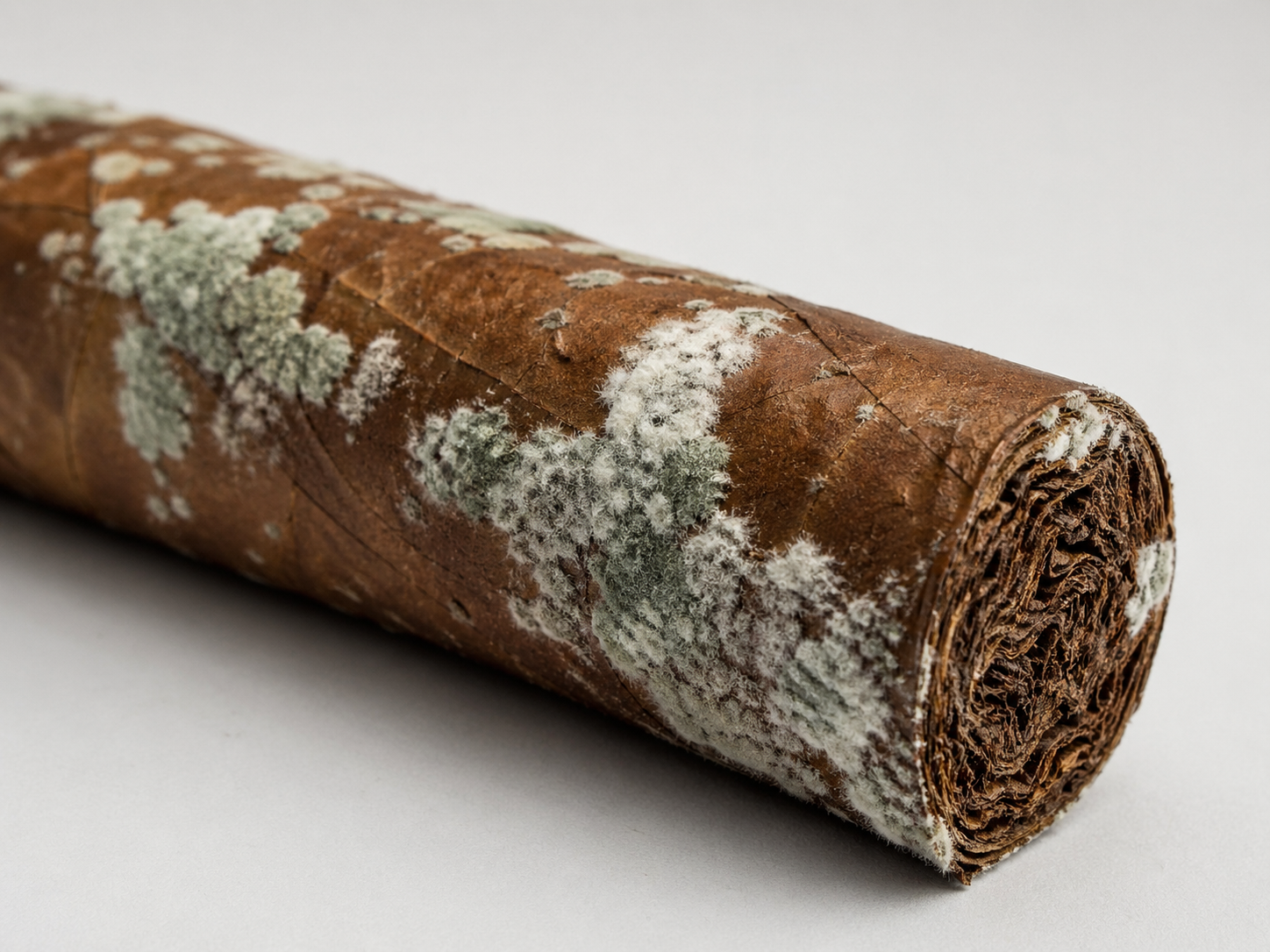
Mold is a fungal growth that can appear on cigars stored in conditions that are too humid, too warm, or poorly ventilated. Unlike plume, mold is a problem. It can spread cigar-to-cigar, ruin a wrapper, alter the flavor, and in some cases, force you to throw out an entire humidor's worth of inventory.
Mold thrives when humidity climbs above the mid-70s and temperatures rise into the upper 70s Fahrenheit. It is most often introduced when a damp sponge, an over-charged humidification device, or a contaminated cigar enters an otherwise healthy humidor.
Caught early, a mold problem is manageable. Caught late, it's heartbreak.
The Five-Second Test: Plume or Mold?
You don't need a microscope. You need a clean finger or a soft brush, and you need to know what you're looking at.
1. Look at the color. Plume is white, off-white, or a very pale grey. It looks like a light dusting of powdered sugar. Mold is colored. Blue, green, yellowish, sometimes a darker grey-black. If you see any color other than white, treat it as mold until proven otherwise.
2. Look at the texture. Plume is flat and powdery — like dust that settled on the wrapper. Mold is fuzzy. Three-dimensional. It has fibers or stands up off the surface like the start of a beard.
3. Look at the location. Plume only forms on the wrapper and the body of the cigar. It does not grow on the foot (the open end you light). Mold has no preference. If the white substance is on the foot, inside the foot, or along the cut end, it is almost certainly mold.
4. Brush it off. Plume wipes away cleanly with a soft brush or a gentle finger. The wrapper underneath looks unchanged. Mold resists. It clings, smears, and often leaves a discolored stain or a dark spot on the wrapper after you've removed it.
5. Smell it. A plumed cigar smells like it always did — sweet, woody, slightly oily. A moldy cigar smells musty, sour, or faintly like a damp basement.
If your cigar passes all five — white, powdery, only on the wrapper, brushes off clean, smells fine — you have plume. Light it and enjoy. If even one test points the other way, set it aside.
What to Do If You Find Mold
Don't panic, but do act quickly.
Pull the affected cigars from your humidor and isolate them. Inspect every other cigar in the box, paying attention to the foot and the cap. Wipe down the inside of your humidor with a cloth lightly dampened with distilled water — never alcohol or soap, which will leach into your remaining cigars and ruin them.
Check your hygrometer. If it's been sitting above 72% relative humidity, that's likely your culprit. Recalibrate or replace it. Check your humidification device next. A waterlogged sponge or oversaturated bead system will push your humidor into mold territory faster than anything else.
Lightly affected cigars — a single spot of surface mold on the wrapper, brushed off clean with no staining — can sometimes be saved by quarantining them, lowering humidity, and watching closely. Cigars with mold on the foot, mold inside the wrapper, or mold that has stained the leaf should be discarded. It's not worth the risk.
How to Encourage Plume (and Prevent Mold)
The same conditions that produce plume are the conditions that prevent mold: stable, moderate humidity, steady temperature, and patience.
Aim for 65–70% relative humidity and 65–70°F. Use distilled water in your humidification device — tap water minerals encourage exactly the kind of microbial growth you're trying to avoid. Rotate your stock every few months so cigars at the bottom of the humidor get the same airflow as cigars on top. And resist the urge to over-humidify; cigars that are too wet burn poorly, taste sour, and invite mold.
Then wait. Real plume takes time. A cigar laid down for six months in good conditions might show the faintest dusting. A cigar aged for two or three years in a properly run humidor can develop a beautiful, even bloom across the wrapper.
The Bottom Line
White, powdery, only on the wrapper, brushes off clean — that's plume, and you've done something right. Colored, fuzzy, on the foot, leaves a stain — that's mold, and it needs to come out of your humidor today.
If you're building a collection worth aging, the foundation is your humidor and the cigars you put in it. Both are worth investing in once. Browse our aged premium cigars and our selection of premium humidors, or if you'd rather have us pick something special each month, take a look at our cigar subscription box.
Stored well, the best cigars only get better.